Grow From AI Ambition to Enterprise Value
Chief Artificial Intelligence Officer Program
 Application closes on
23rd Oct 2026
Application closes on
23rd Oct 2026

 Speak with our expert
+1 919 709 0136
Speak with our expert
+1 919 709 0136




Learn more about the course
Get details on syllabus, projects, tools, and more

Chief Artificial Intelligence Officer Program
Application closes 23rd Oct 2026
Why should you participate in this program?
-

Applied Capstone Project
Develop an executive-ready blueprint by applying program insights to a real opportunity in your organization, drawing on faculty and industry expertise and peer feedback
-
On-Campus Immersion
Experience two 5-day on-campus immersions at the Duke University campus in Durham, N.C., USA, along with live online modules, that will enhance your learning and networking


KEY OUTCOMES
How will you deliver AI-led transformation?
Grow from AI awareness and ambition to AI leadership and enterprise value
-
Identify where AI can create meaningful enterprise value across business functions
-
Distinguish credible AI opportunities from hype-driven activity
-
Engage CEOs, boards, governance partners, and cross-functional stakeholders on AI strategy
-
Balance speed, experimentation, risk, trust, and accountability in AI initiatives
-
Design AI initiatives grounded in real workflows, data, and adoption realities
-
Build practical roadmaps for responsible execution and enterprise-wide scale
Rankings
-
#7 in Business Analytics
QS World University Rankings by Subject, 2026
-
#5 in Executive MBA
US News and World Report, 2025
-
#5 in Full-Time MBA, Marketing, 2025
US News and World Report , 2025


What program benefits will you receive?

The Duke CAIO Program certificate from Duke Executive Education, The Fuqua School of Business, and Pratt School of Engineering
Inclusion in The Fuqua School of Business alumni LinkedIn network, a private group with 15,000+ alumni members
Access to CareerBridge, Fuqua’s job board, an exclusive resource for Fuqua degree students and alumni job seekers
Inclusion in the Duke University alumni directory and the ability to join Duke’s affinity, industry, and regional groups
Ability to post targeted career opportunities for your organization through Fuqua’s Career Management Center job portal
Access to Fuqua’s alumni events and webinars
Access to Fuqua’s Ford Library while on campus
The monthly alumni e-newsletter, Team Fuqua Flash, from Fuqua’s Alumni Relations team
30% discount on future Duke Executive Education program registrations (Global partner programs excluded)
*All benefits are subject to change
Key program highlights
Why choose the CAIO Program?
-
Blended Format - On-Campus and Live-Online Modules
Immersive live-online sessions and two 5-day on-campus modules at Duke University to enhance learning and networking with faculty and peers
-
Expert Faculty and Industry Leaders
Learn from faculty across Fuqua, Pratt, and Duke’s broader expertise domains, and industry experts throughout the program, including exclusive masterclass webinars
-
Real-World Applications
Explore real-world case studies and simulations to confront the realities of leading transformation
-
Applied Capstone Project
Apply program insights to a real opportunity in your own organization, drawing on faculty and industry expertise and peer feedback across six structured sprints
-
Governance Workshops
Hone core leadership capabilities: governance, board dialogue, decision rights, and human-in-the-loop design
-
Transformation Simulations
Participate in a high-stakes strategy simulation to implement AI-driven enterprise-level transformation
-
Signature Experience
Immerse yourself in the Duke Basketball Signature Experience, gaining leadership insights developed by Hall of Fame Coach Mike Krzyzewski (Coach K)
-
Credential and Network Access
Earn credentials from Duke Executive Education, The Fuqua School of Business, and Pratt School of Engineering, and exclusive program benefits


Skills you will learn
Enterprise Value Mapping & Qualification
Boardroom & Executive Stakeholder Advocacy
Strategic AI Portfolio Design
Responsible AI Governance Framework Architecture
AI Capital Allocation Under Financial Pressure
Networked & Cross-Functional Change Management
Pre-Deployment Risk & Vulnerability Assessment
Perpetual Business Model Reinvention
Enterprise Value Mapping & Qualification
Boardroom & Executive Stakeholder Advocacy
Strategic AI Portfolio Design
Responsible AI Governance Framework Architecture
AI Capital Allocation Under Financial Pressure
Networked & Cross-Functional Change Management
Pre-Deployment Risk & Vulnerability Assessment
Perpetual Business Model Reinvention
view more
- Overview
- Learning Path
- Curriculum
- Projects
- Certificate
- Faculty
- Fees
Who is this program ideal for?
Senior leaders to grow from AI awareness and ambition to AI leadership and enterprise value
-
C-Suite Leaders: CEOs, CFOs, COOs, CHROs, and CXOs
Accountable for AI strategy, risk assessment, and determining how AI ambition translates into measurable enterprise value
-
Senior Leaders
Responsible for aligning boards and stakeholders, and mobilizing organizations toward responsible and sustainable AI
What makes this program distinctive?
-
Senior Leader Lens on AI
Move beyond tools and use cases to examine how AI changes value creation, delivery, and capture, connecting strategy to measurable outcomes
-
Strategy to Value Execution
Assess maturity, identify credible opportunities, match objectives to solution patterns, and move from experiment to enterprise impact
-
Governance, Ethics, and Trust
Apply responsible AI as a core leadership capability, not a compliance afterthought with governance, board dialogue, and human-in-the-loop design
-
Hands-On, AI-Enabled
Experience the scope of AI-enabled creation through immersive exercises that involve ideation, prototyping, planning, and human judgment
-
Transformation Under Pressure
Through cases and simulations, learn to confront the realities of leading transformation like scarce capital, board scrutiny, and talent constraints





What will you learn in the program?
The curriculum moves from foundational AI perspectives through an intensive in-person residency to a sustained, real-world Capstone journey, combining faculty instruction, live case studies, hands-on innovation exercises, and a multi-round strategic simulation
Module 1: Foundations
- Strategy, Governance, and Innovation and Implementation, three foundational lenses on AI - Business model innovation and organizational transformation - External regulation and internal AI governance - Distinguishing AI capability from vendor hype; identifying risk before deployment
Module 2: Strategy, Governance, and Innovation (5 days on campus)
- AI strategy and enterprise value creation; building a three-horizons strategic portfolio - Managing AI in business — from maturity assessment to execution model - Board engagement and AI governance — decision rights, accountability, and boardready narratives - Responsible AI and earning workforce trust - Live case studies on AI implementation, including unanticipated consequences and recovery - Cybersecurity and AI decision architecture - Hands-on innovation — from concept ideation to working prototype - Balancing AI opportunity and risk; capital allocation under uncertainty - Transform Simulation — a multi-round strategic exercise in leading transformation under competitive and financial pressure
Module 3: Applied Capstone Sprints, and Education Interludes
- Sprint 1: Set the Standard - Sprint 2: Focus the Opportunity - Sprint 3: Expose Failure Modes - Sprint 4: Pressure Test Reality - Sprint 5: Mobilize for Execution - Sprint 6: Build and Deliver - Enterprise Implementation - Ethics, Governance, and Compliance - Business Models and Experimentation - Organization Transformation - Practical Enterprise Governance
Module 4: Leading People, Self, and Perpetual Transformation (5 days on campus)
- Essential Tools for Modern Leadership - Executive Presence and Influence - Mindfulness and Resilient Leadership - Networked Leadership — Leading Change from the Middle Out - Internal Venturing - Activating Principled People-Centered Transformation - Chronicling the Learning Journey — Looking Back to Look Forward - Perpetual Business Model Innovation - Agile Leadership through Ambiguity and Uncertainty - The Innovative Organization — Entrepreneurial Mindset & Breaking the Paradigm - Duke Basketball: Dynamic and High-Performing Teams - Double Loop Learning and WHO/AHA/HMM Reflection - Capstone Projects: Executive Forum and Program Evaluation - Capstone Superlatives and Graduation Ceremony
Note: The curriculum listed above are indicative and subject to updates as technology evolves.
Capstone Project
Leverage AI in business transformation and address real-world challenges through six sprints

Project Details
Develop and Execute a Comprehensive AI Strategy
Description
At the center of the program, each participant applies the program's concepts to a strategic AI opportunity within their own company, division, business function, or product line. Participants develop an executive-ready plan connecting business value, stakeholder needs, organizational readiness, data and technology considerations, risk, governance, and implementation realities.
Sprint 1 — Set the Standard
Anchor the Capstone Project in enterprise value rather than isolated use cases or tools, and establish the criteria for a credible AI opportunity.
Sprint 2 — Focus the Opportunity
Move from a general value area to a credible, focused opportunity — specific enough to study, test, and develop.
Sprint 3 — Expose Failure Modes
Surface the risks, gaps, and organizational conditions that could cause the opportunity to stall, before it is over-designed or disconnected from enterprise reality.
Sprint 4 — Pressure Test Reality
Stress-test feasibility across data, technology, and organizational readiness to determine whether the opportunity is practical, governable, and auditable.
Sprint 5 — Mobilize for Execution
Convert the strategy into an actionable roadmap with clear sequencing, ownership, and investment logic.
Sprint 6 — Build and Deliver
Synthesize the work into a defensible, executive-ready AI initiative blueprint with a clear recommendation and path forward.
Skills you will learn
- Opportunity Identification
- AI Strategy Development
- Stakeholder Communication
- Risk Assessment and Mitigation
- Resource Allocation
- Monitoring and Adaptation Methodology
- Comparative AI Prioritization
- "Human-in-the-Loop" Design
- Cross-Functional AI Operating Model Design
- Value Hypothesis & "Why Now" Justification
- Organizational Trust & Incentive Alignment
Note: The projects listed above are indicative and subject to updates to the curriculum.
Program Faculty
-
Co-Academic Program Director
Tony O'Driscoll
Co-Academic Program Director; Adjunct Professor of Business Administration, The Fuqua School of Business; Adjunct Professor of Engineering, The Pratt School of Engineering
Tony O’Driscoll is an Adjunct Professor at Duke University’s Fuqua School of Business and the Pratt School of Engineering. His work sits at the intersection of business, technology, innovation, and learning, with a focus on how emerging technologies reshape organizational leadership and per...
Know More -
Co-Academic Program Director
Stephanie Fruth
Co-Academic Program Director; Adjunct Professor of Business Administration, The Fuqua School of Business; Adjunct Professor of Engineering, The Pratt School of Engineering
Stephanie Fruth is Adjunct Professor of Business Administration, The Fuqua School of Business; Adjunct Professor, Pratt School of Engineering. She is a management strategy consultant and educator who brings together her passion and experience in strategy and operations to help her clients succeed. S...
Know More



 LinkedIn Profile
 University Link
Program faculty may include:
-
Shep Moyle
Senior Lecturing Fellow, Duke Innovation & Entrepreneurship
Led Shindigz as president, CEO, and chairman for 31 years
Created major Tostitos product lines, driving sales to $1.5B
Know More
-
Sharique Hasan
Associate Professor of Strategy
Published research in leading journals across strategy and innovation
Award-winning Duke faculty member teaching strategy and implementation
Know More
-
Veronica Root Martinez
Simpson Thacher & Bartlett Distinguished Professor of Law
Nation’s leading academic expert on monitors and monitorships
Former Notre Dame Law professor, recipient of multiple teaching awards
Know More -
Christopher Bail
Professor of Sociology, Duke University
Director of the Trinity Social AI Initiative
Professor of Computer Science and Political Science
Know More -
Manuel Adelino
Senior Associate Dean for Faculty and Professor of Finance
Ph.D. in Financial Economics, MIT Sloan
Former Business Analyst, McKinsey Lisbon
Know More
-
Sasa Pekec
Peterjohn-Richards Distinguished Professor of Business Administration, Fuqua School of Business
President, INFORMS Auctions & Market Design
Council of Economic Advisors, Croatia (2010–2015)
Know More -
Brinnae Bent
Executive in Residence, Pratt School of Engineering
Has appeared in multiple notable publications
Featured in Duke Today and Pratt School of Engineering news articles
Know More -
Michael Roman
Executive in Residence and Director of the Applied AI-Cyber Lab, Pratt School of Engineering
Over 15 years of experience in cybersecurity, defense, and more
Founder of TwoTen Labs
Know More -
Scott Dyreng
Senior Associate Dean for Innovation and Professor of Accounting, The Fuqua School of Business
Featured in The Accounting Review, Journal of Financial Economics, etc
Three-time winner of the Excellence in Teaching Award in the Duke MMS
Know More -
Ryan Bolick
Adjunct Assistant Professor, Pratt School of Engineering; Lecturing Fellow, Duke Innovation & Entrepreneurship
Diverse background in SaaS, AI, and FDA-cleared devices
Expertise in UI/UX, web development, and branding
Know More -
Jamie Jones
Associate Professor of the Practice and Director for Duke Innovation & Entrepreneurship
Co-founder at Impact Engine
Recognized by the Triangle Business Journal 40 Under 40
Know More -
Lee Tiedrich
Adjunct Professor in the Engineering Graduate and Professional Programs, Pratt School of Engineering
Leader in AI, data, and emerging technologies
Senior AI Advisor at the US NIST
Know More -
Brian Solis
Head of Global Innovation, ServiceNow
9 times best-selling author
Studied Digital Darwinism
Know More -
Christian Rangen
Global Strategy Advisor, Strategy Tools
Author, keynote speaker and faculty
Strategy and transformation advisor
Know More -
Phaedra Boinodiris
Global Leader for Trustworthy AI, IBM Consulting
Named the 2030 Responsible AI Leader of the Year
Recognized as one of the Top 100 Women in the Games Industry
Know More -
Michael Mazzoleni
Adjunct Assistant Professor, Engineering Graduate and Professional Programs, Pratt School of Engineering
Works across engineering, data science, and human performance research
Has several publications under his name
Know More

.jpg "Sharique Hasan")


 (1).jpg "Manuel Adelino")










Earn your certificate of completion
Get the Chief Artificial Intelligence Officer Program certificate from Duke Executive Education, Duke University's Fuqua School of Business, and Duke University Pratt School of Engineering upon program completion.
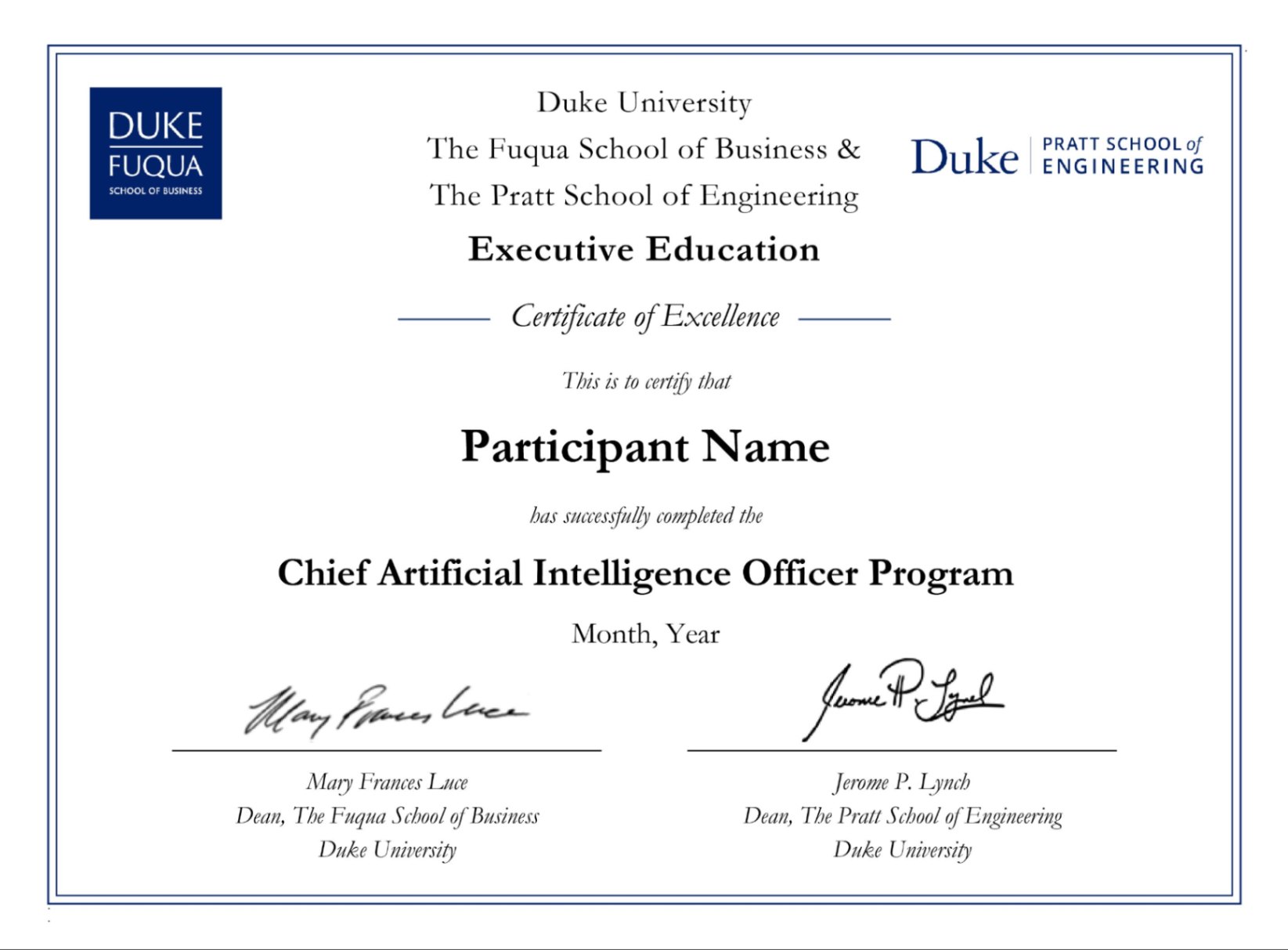
* Image for illustration only. Certificate subject to change.
Program Fee
The program fee is USD 25,000
Invest in your career
-
Covers teaching fees, all academic materials, lunches, and select dinners
-
Does not include transport or visa expenses, nor accommodation for modules and/or workshops, etc.
-
Application fee for the Duke CAIO Program is USD 200
-
Refunds available only in the case that an applicant is not offered admission to the program


Admission Process
The program follows a simple 3-step application process. The step-by-step process is outlined below.
-
1. Submit Application
Candidates can apply online and attach all required materials.
-
2. Rolling Admission
The Admissions team will assess your application as soon as it is received.
-
3. Interview
An interview might be required. Admissions team notifies candidates after all requirements are met
-
Note :
The application fee is USD 200 and application fee is refunded only in the case that an applicant is not offered admission to the program.


Program Eligibility
- A minimum of 10 years of work experience in functional, technical, or business roles
- A graduate degree with a strong academic track record is preferred
- Fluency in written and spoken English
Delivered in Collaboration with:

Duke University’s Fuqua School of Business and Duke University Pratt School of Engineering are collaborating with Great Learning to deliver the Chief Artificial Intelligence Officer (CAIO) Program. Great Learning is an ed-tech company that has empowered learners from over 170+ countries in achieving positive outcomes for their career growth.
 Application Closes
23rd Oct 2026
Application Closes
23rd Oct 2026